Microplastics in Water: Building a Reliable Reference Material Framework
Published 4 June 2026 · By Dr Ingrid Sorensen, Senior Scientist, Microplastics and Emerging Contaminants
Microplastics analysis is arriving in the regulated space from an unusual direction. Most contaminants enter regulation after decades of routine measurement; microplastics are entering it while the measurement itself is still being standardised. The recast EU Drinking Water Directive placed microplastics on the watch list and required a harmonised methodology, and water utilities are now building capability ahead of firm limits. The central challenge is not detection. It is comparability.
Why this measurement resists conventional metrology
A certified reference material for a dissolved contaminant carries a mass concentration with an uncertainty. Microplastics do not reduce so neatly. A meaningful result describes a population of particles, and each of the following affects the number reported:
- Polymer identity — polyethylene, polypropylene, PET, PVC, polystyrene and polyamide each behave differently through sampling, digestion and identification.
- Size distribution — counts rise steeply as the lower size cut-off decreases, so a result is meaningless without the size range stated.
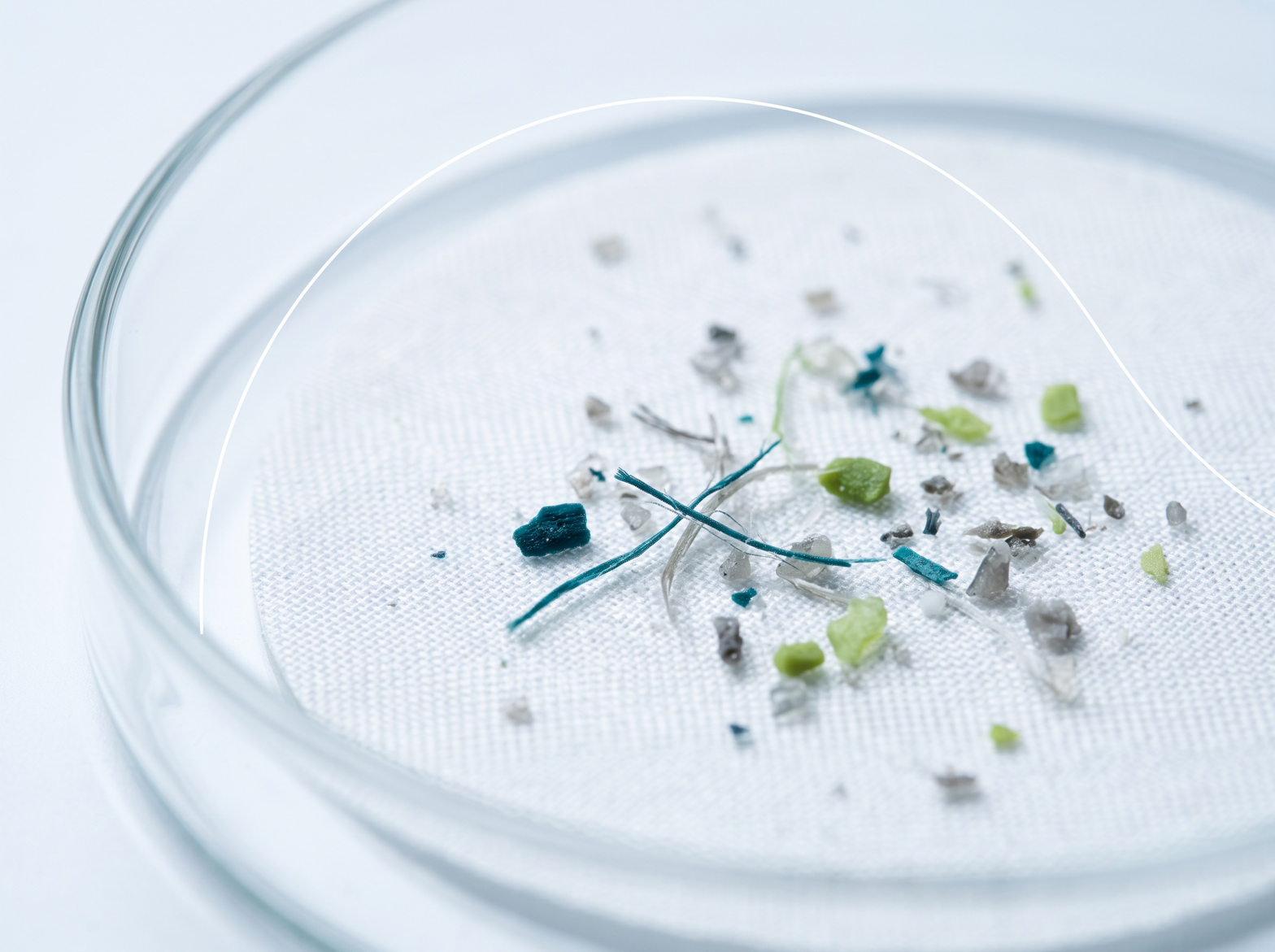
- Morphology — fragments, fibres, films and spheres are recovered with very different efficiency, and fibres are the most commonly miscounted class.
- Weathering state — environmental particles carry oxidised surfaces and biofilm that alter both density and spectral match quality.
- Reporting unit — particles per litre, mass per litre and surface area per litre are not interconvertible without assumptions that are rarely stated.
Two competent laboratories analysing the same water can legitimately report counts differing by an order of magnitude simply because they applied different size cut-offs and morphology criteria. That is a harmonisation problem, and reference materials are the instrument for solving it.
What a useful microplastics reference material provides
The materials now emerging fall into several categories, each answering a different question in the workflow:
- Spectroscopic identity standards — well-characterised polymer materials used to build and verify the spectral libraries that FTIR and Raman identification depend on.
- Size and count standards — monodisperse or defined-distribution particles with a known number concentration, used to establish counting accuracy and instrument calibration.
- Spiking suspensions — defined mixtures of polymer types, sizes and shapes added to a real sample at the start of the procedure to measure whole-method recovery.
- Matrix materials — water or sediment containing characterised particle loads, used to assess trueness under realistic conditions.
Whole-method recovery is the critical measurement. Losses occur at filtration, during oxidative digestion of organic matter, in density separation and through static adhesion to glassware. Without a spike carried through every one of those steps, a laboratory has no basis for correcting its counts or for explaining them to an auditor.
Contamination control is the whole game
No other routine analysis is so vulnerable to contamination from the laboratory itself. Polyester lab coats, airborne fibres, plastic sample containers, wash bottles and pipette tips all contribute. Credible programmes adopt cotton laboratory clothing, glass and metal labware throughout, laminar flow or filtered enclosures for sample handling, and procedural blanks processed alongside every batch. Blank correction must be documented rather than applied silently, because the blank frequently accounts for a substantial share of the fibres detected.
Towards harmonisation
Standardisation bodies are converging on defined size classes, mandatory reporting of the lower size limit, polymer identification by vibrational spectroscopy with stated match thresholds, and blank reporting alongside sample results. Interlaboratory studies run over the last few years have shown that agreement improves dramatically once participants are given a common spiking material and a common counting convention — which is the clearest evidence available that the reference material framework, not the instrumentation, is the limiting factor.
Practical advice for laboratories building capability
- Define and publish your size range and morphology criteria before generating any reportable data.
- Choose a spiking material that includes fibres, not only spheres, because fibres expose the weaknesses in a method.
- Establish blank levels before establishing detection limits.
- Participate in interlaboratory comparisons early; the first round is diagnostic, not a judgement.
- Record polymer identification thresholds and library versions as part of the method record.
The bigger outcome
Microplastics data will shape treatment investment, packaging policy and public confidence in drinking water for years. Numbers that cannot be compared between laboratories cannot support any of those decisions. Building the reference material framework now — characterised particles, honest blanks, harmonised reporting — is what will allow the science to carry the weight that is about to be placed on it.
Written by
Dr Ingrid Sorensen
Senior Scientist, Microplastics and Emerging Contaminants
Ingrid works on particulate and polymer reference materials for water and environmental monitoring, supporting laboratories building microplastics capability under emerging European drinking water and marine monitoring requirements.
More from the blog

Metrological Traceability: The Unbroken Chain Behind Every Trusted Result

From Score to Strategy: Turning Proficiency Testing Results into Lab Improvement